White Paper & Manufacturing Intelligence

High-Quality DC Rated Circuit Breakers Factories & Manufacturers

Next-Generation DC Overcurrent, Short-Circuit & Arc Protection Solutions for Solar PV, Utility Energy Storage (BESS), Electric Vehicle Infrastructure & Industrial Automation

Featured Industrial & DC Breaker Series

Precision-Engineered Low-Voltage Protection Devices Certified to International Electrical Standards
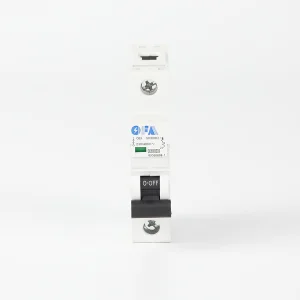
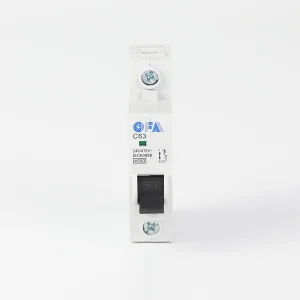
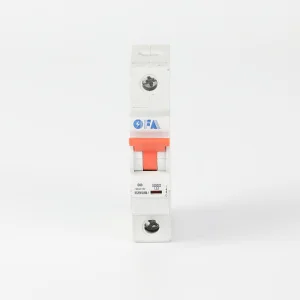
OEM OFPF Series 1P Miniature Circuit Breaker Supplier

OEM OFPF Series 1P Miniature Circuit Breaker

View Product Details
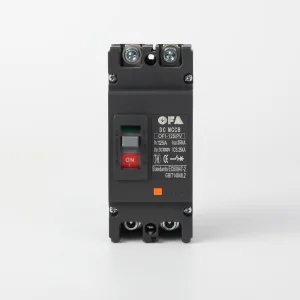
OEM OF1-125/PV DC Molded Case Circuit Breaker Manufacturers

OEM OF1-125/PV DC Molded Case Circuit Breaker

View Product Details
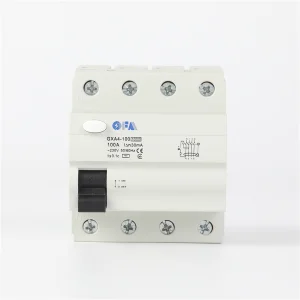
High-Quality OFGX 4P100A Residual Current Circuit Breaker

High-Quality OFGX 4P100A Residual Current Breaker

View Product Details
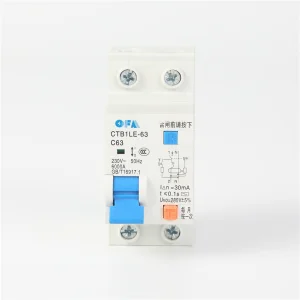
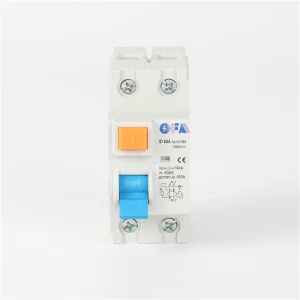
China OFC 63A Residual Current Circuit Breaker

China OFC 63A Residual Current Breaker with Protection

View Product Details
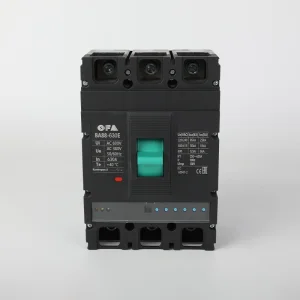
High-Quality BA88-630E Circuit Breaker

High-Quality BA88-630E Molded Case Circuit Breaker

View Product Details
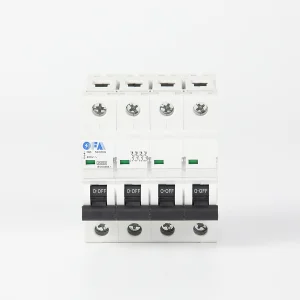
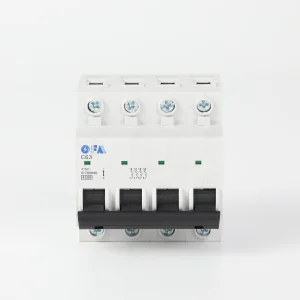
OEM OFPF Series 4P Miniature Circuit Breaker

OEM OFPF Series 4P Miniature Circuit Breaker

View Product Details
High-Quality OFID 2P High-Performance DC Molded Case Circuit Breaker

High-Quality OFID 2P High-Performance DC MCCB

View Product Details
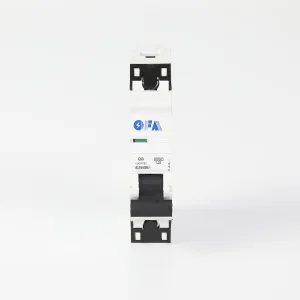
High-Quality OFDZ47 Series 1P Miniature Circuit Breaker

High-Quality OFDZ47 Series 1P Miniature Breaker

View Product Details

The Engineering Physics of Direct Current (DC) Interruption

Understanding Why Industrial-Grade DC Breaker Manufacturing Demands Advanced Electromagnetic Arc Extinction and Precision Thermal Design

The Absence of Natural Zero-Crossing

Unlike Alternating Current (AC) electrical distribution where current naturally passes through a voltage zero-crossing point 100 or 120 times per second—allowing arc extinguishment at natural zero—Direct Current (DC) maintains a continuous magnitude and unidirectional electron flow. When contact separation occurs under high DC voltages (such as 1000V DC or 1500V DC in solar PV arrays), the electric arc sustained between contacts does not self-extinguish. It generates extreme localized temperatures exceeding 6,000°K, causing rapid contact erosion and catastrophic plasma flashovers if not suppressed within milliseconds.

Permanent Magnet Blowout & De-ion Arc Chutes

Top-tier DC Circuit Breaker manufacturers resolve arc persistence by integrating high-coercivity permanent magnetic blowout coils and multi-splitter de-ionizing arc chutes. Upon contact opening, the permanent magnet creates a transverse magnetic field perpendicular to the arc path. Utilizing the Lorentz force ($\mathbf{F} = q\mathbf{E} + q\mathbf{v} \times \mathbf{B}$), the arc is dynamically stretched and forced upward at supersonic velocities into the splitter plates. The arc chute divides the single high-voltage arc into dozens of series micro-arcs, cooling the plasma and elevating the arc voltage above the system supply voltage to force immediate breakdown and extinction.

Technical Matrix: AC vs. High-Performance DC Circuit Protection Parameters

Engineering Attribute Standard AC Circuit Breaker Enterprise-Grade DC Circuit Breaker (OFA Series) Industrial Impact / Application Advantage
Arc Extinction Dynamics Relies on natural sinusoidal AC zero-crossing point. Active Lorentz magnetic blowout force + expanded arc chutes. Prevents sustained ionized arcs in 500V - 1500V DC circuits.
Polarity Sensitivity Non-directional / Non-polarized. Polarized (+/- designated) & Non-Polarized options available. Ensures safe isolation in bidirectional BESS charge/discharge loops.
Contact Material Alloy Standard Silver-Cadmium Oxide ($AgCdO$). Refractory Silver-Nickel ($AgNi$) or Silver-Tin Oxide ($AgSnO_2$). Resists contact welding and material migration under high DC current.
Time Constant ($L/R$) Typically ignored (power factor $\cos\phi$ driven). Rated for $L/R = 5\text{ms}$ up to $15\text{ms}$ time constants. Safely interrupts heavy inductive loads in DC motors & energy banks.
Short-Circuit Interrupting ($I_{cu}$) 6kA - 50kA at 400V AC. 10kA - 100kA at 1000V/1500V DC (Molded Case execution). High breaking capacity protects multi-megawatt solar PV strings.

Macro Industry Solutions & System Architecture Integration

Deployment Scenarios across Utility-Scale Solar PV, Battery Energy Storage (BESS), EV Charging Networks & Data Centers

1. Utility Solar PV Systems (1000V - 1500V DC)

In modern centralized and string solar installations, DC circuit breakers serve as the primary defensive isolation layer within DC Combiner Boxes, Re-combiners, and Central Inverters. Rated DC MCBs and MCCBs (such as OFA's OF1-125/PV and OFID Series) isolate faulty photovoltaic strings suffering from reverse-current feed, insulation breakdown, or ground faults. Their high impulse withstand voltage ($U_{imp} \ge 8\text{kV} - 12\text{kV}$) guarantees lightning surge resilience across vast solar fields operating in harsh desert or tropical environments.

2. Battery Energy Storage Systems (BESS)

Utility-scale Containerized Energy Storage Systems (C&I BESS) utilize Lithium Iron Phosphate ($\text{LiFePO}_4$) battery racks capable of delivering massive prospective short-circuit peak currents ($>50\text{kA}$) within microsecond timeframes. Non-polarized bidirectional DC MCCBs are essential to handle power flow reversals seamlessly during charge and discharge cycles. They prevent thermal runaway damage by rapidly disconnecting energy racks from Power Conversion Systems (PCS) upon detecting overcurrent or short-circuit triggers.

3. EV Ultra-Fast Charging Networks (DCFC)

High-power Direct Current Fast Chargers (150kW to 480kW MCS Megawatt Charging Systems) step down grid voltage and rectify it into variable 200V - 1000V DC outputs. Compact DC circuit breakers installed at the power sub-distribution module ensure immediate protection for electric vehicle battery packs, liquid-cooled charging cables, and internal power electronic stacks (IGBT/SiC modules), safeguarding against insulation leakage and high-voltage line shorts.

4. Telecom & Data Center 380V HVDC Distribution

Modern hyperscale data centers are transitioning from legacy AC UPS to 380V High Voltage Direct Current (HVDC) distribution architectures to eliminate AC/DC transformation losses, boosting energy efficiency by 8-12%. High-reliability DC MCBs (such as OFA's OFDZ47 Series) offer selective, cascading overcurrent protection at server rack distribution units (PDUs), preventing localized faults from tripping main rack feeders.

5. Industrial Automation & Transit Systems

DC breakers are vital for electrifying heavy industrial overhead cranes, automated guided vehicles (AGVs), light rail transit signaling networks, and mining DC traction sub-stations. They resist extreme mechanical vibration, high environmental humidity, and cyclic electromagnetic spikes, ensuring 24/7 continuous industrial productivity.

China Smart Factory 4.0: Supply Chain Resilience & Manufacturing Edge

Inside Wenzhou OFA Electrical Technology Co., Ltd. — Yueqing's Advanced Hub for High-Reliability Low-Voltage Switchgear

Decade-Plus Industrial Legacy in Yueqing Cluster

Founded in 2013, Wenzhou OFA Electrical Technology Co., Ltd. is rooted in Yueqing, Wenzhou—globally recognized as the "Capital of Electrical Appliances in China." By leveraging the world's most concentrated electrical component supply chain cluster, OFA achieves unparalleled efficiency in raw material sourcing, high-precision molding, contact stamping, and rapid prototyping. We operate under independent brands such as "OFA" while acting as an elite OEM/ODM contract manufacturer for Fortune 500 electrical brands.

Uncompromising Zero-Defect Quality Assurance

OFA operates under strict ISO9001 Quality Management Systems. Our automated production lines feature 100% full-inspection Standard Operating Procedures (SOPs). Every single DC breaker undergoes automated optical inspection (AOI), laser thermal calibration, instantaneous magnetic tripping verification, and dielectric withstand voltage testing. Demonstrating corporate integrity and financial reliability, OFA has been officially rated as Tax Credit Grade A for seven consecutive years.

13+
Years Industry Experience
780+
Global Enterprise Partners
100+
Countries Export Footprint
7 Yrs
Grade A Tax Credit Rating

Technical Roadmap: Next-Generation DC Circuit Protection

Pioneering Solid-State Circuit Breakers (SSCB), IoT Telemetry, and Green Eco-Friendly Polymers

Phase 1: Present

Hybrid Electromagnetic Interruption

Integrating mechanical contacts with semiconductor transient voltage suppressors (TVS) and magnetic blowout coils. Reduces arcing time to under 3 milliseconds, dramatically reducing contact degradation while maintaining ultra-low contact resistance during steady-state conduction.

Phase 2: Emerging

Smart IoT & Predictive Maintenance

Integrating smart microcontrollers and Modbus/RS485 & CANbus communication interfaces directly into DC Molded Case Breakers. Enables real-time telemetry monitoring of contact temperature rise, cumulative breaking wear, current harmonics, and predictive arc fault detection (AFCI).

Phase 3: Next-Gen

Solid-State Breakers (SSCB) & SiC Tech

Utilizing Silicon Carbide (SiC) and Gallium Nitride (GaN) power semiconductors to achieve microsecond ($<10\mu\text{s}$) zero-arc isolation. Completely eliminates mechanical arcing, making it ideal for hydrogen generation plants and explosive marine environments.

Global Enterprise Procurement & Regulatory Compliance Guide

Essential Standards, Certification Frameworks, and Customization Capabilities for International Buyers

International Testing Standards Alignment

Global electrical safety requires strict conformity to market-specific access regulations. Premium DC Circuit Breaker factories build products compliant with the following frameworks:

  • IEC 60947-2 / EN 60947-2: Standard for Low-Voltage Switchgear and Controlgear (Circuit-Breakers for Industrial Applications).
  • UL 489B: Specific Standard for Molded-Case Circuit Breakers and Enclosures for Use in Photovoltaic (PV) Systems across North America.
  • IEC 60898-2: Circuit-breakers for overcurrent protection for household and similar installations (DC operated).
  • CCC & GB/T 14048.2: Chinese National Quality Standards for industrial low-voltage circuit protection.

Tailored OEM/ODM Customization Capabilities

Recognizing that EPC contractors, panel builders, and equipment manufacturers face unique enclosure space constraints and ambient thermal dynamics, OFA provides comprehensive custom engineering services:

  • Custom Tripping Curves: Calibration for B, C, D, and specialized PV/BESS tripping characteristics.
  • Voltage Parameter Tuning: Standard models engineered for 250V, 500V, 750V, 1000V, and 1500V DC.
  • Private Labeling & Brand Integration: Laser-etched custom logo, custom packaging, and private compliance documentation.
  • Auxiliary Accessories: Factory-installed Shunt Trips (MX), Under-Voltage Trips (MN), Auxiliary Switches (OF), and Alarm Contacts (SD).

Frequently Asked Questions (FAQ)

Expert Engineering Clarifications for Procurement Directors, System Integrators & Electrical Engineers

What is the fundamental difference between standard AC circuit breakers and DC-rated circuit breakers?
AC circuit breakers rely on the natural zero-crossing of alternating current (occurring 100 or 120 times per second) to extinguish the electrical arc formed during contact separation. Direct current (DC) has no zero-crossing point, making the arc continuous and significantly harder to suppress. DC-rated circuit breakers incorporate specialized magnetic blowout coils, enhanced arc chutes with additional cooling plates, wider contact gaps, and specialized silver-alloy contact tips designed specifically to break intense DC arcs up to 1500V DC safely.
Can I use a polarized DC breaker in a Battery Energy Storage System (BESS)?
No, standard polarized DC breakers should not be used in bidirectional circuits such as BESS. Polarized DC breakers specify fixed "+" and "-" line/load terminals because their internal magnetic blowout field is designed for current flowing in one direction. In battery energy storage, current flows in one direction during charging and reverses during discharge. Flowing current in reverse through a polarized breaker forces the arc *away* from the arc chute during a fault, causing catastrophic breaker destruction. You must select non-polarized (bidirectional) DC circuit breakers, such as OFA's specialized non-polarized DC MCCB series.
How do ambient temperature and altitude affect DC breaker ratings in solar PV plants?
High ambient temperatures (e.g., above 40°C in outdoor PV combiner boxes) degrade the thermal dissipation of bi-metallic thermal release elements, requiring thermal derating factor adjustments (typically 0.85 - 0.95 multiplier on rated current $I_n$). High altitudes (above 2000 meters) have lower air density, which reduces dielectric insulation properties and convective cooling capacity. At high altitudes, operational voltage ($U_e$) and rated continuous current ($I_n$) must be derated according to IEC 60947-2 guidelines.
What is the significance of the time constant ($L/R$) in DC circuit breaker selection?
The time constant ($L/R$ ratio, expressed in milliseconds) defines how quickly the fault current rises in a DC circuit. A purely resistive circuit has an $L/R$ close to 0ms (fast arc quenching), whereas highly inductive circuits (such as DC motors, long cable runs, or transformer rectifiers) have $L/R$ values of 10ms to 15ms. Circuit breakers must be rated to interrupt currents under the specific $L/R$ time constant of the target application; otherwise, intense stored magnetic energy can sustain the arc beyond the breaker's quenching capability.
What minimum order quantities (MOQ) and delivery lead times does OFA offer for OEM buyers?
Wenzhou OFA Electrical Technology Co., Ltd. maintains flexible procurement policies. Standard stock models (such as standard MCBs and MCCBs) have flexible low MOQs starting from 50 to 100 units. Custom OEM orders featuring private branding, custom voltage calibrations, or specialized terminal blocks typical require 500+ units. Lead times range from 7 to 15 days for standard catalog items, and 20 to 30 days for customized volume OEM shipments.
How does OFA ensure strict quality control across high-volume production runs?
OFA employs a comprehensive 100% full-inspection standard operating procedure (SOP). Production incorporates automated assembly, Automated Optical Inspection (AOI) for contact positioning, digital calibration of thermal-magnetic trip units, and full dielectric insulation testing. Every single unit leaving our ISO9001-certified Yueqing facility is fully traceable to raw material batches, ensuring out-of-factory defect rates remain strictly near zero.

Complete Circuit Protection Product Portfolio

Explore Extended Ranges of Miniature, Molded Case, Residual Current & Smart Isolator Breakers
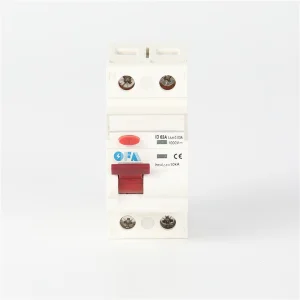
OEM OFID 2P Series Residual Current Circuit Breaker

OEM OFID 2P Series Residual Current Breaker

View Product Details
High-Quality OFD4Z7 Series 1P Miniature Circuit Breaker

High-Quality OFD4Z7 Series 1P Miniature Breaker

View Product Details
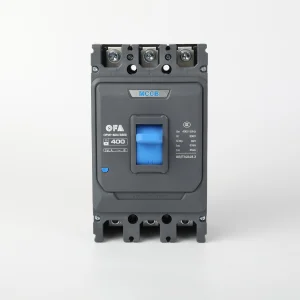
OEM OFA-M1 Series 400 A Molded Case Circuit Breaker

OEM OFA-M1 Series 400A Molded Case Circuit Breaker

View Product Details
High-Quality OFL7 Series 1P Miniature Circuit Breaker

High-Quality OFL7 Series 1P Miniature Breaker

View Product Details
OEM OFDZ47 Series 4P Miniature Circuit Breaker

OEM OFDZ47 Series 4P Miniature Circuit Breaker

View Product Details
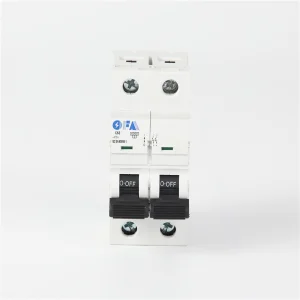
China OF6KA Series 2P Miniature Circuit Breaker

China OF6KA Series 2P Miniature Circuit Breaker

View Product Details
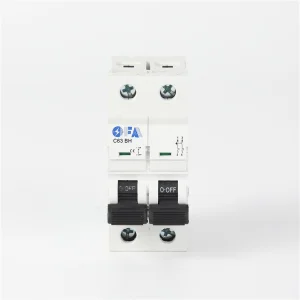
China OFIS-BH Series 2P Miniature Circuit Breaker

China OFIS-BH Series 2P Miniature Isolator Breaker

View Product Details
OEM OFBLT 2P 320A High-Performance Circuit Breaker

OEM OFBLT 2P 320A Molded Case Circuit Breaker

View Product Details

Partner with Wenzhou OFA Electrical Technology Co., Ltd.

Your trusted OEM/ODM manufacturing partner for distribution switchgear, DC protection devices, and energy efficiency solutions. Rooted in Yueqing with over a decade of verified engineering excellence.

Request Technical Consultation & OEM Quote