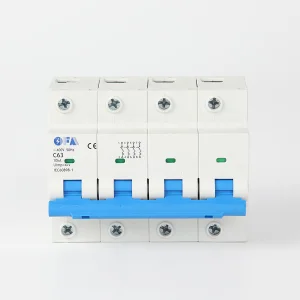
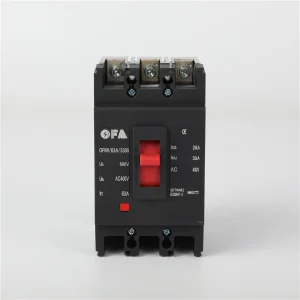
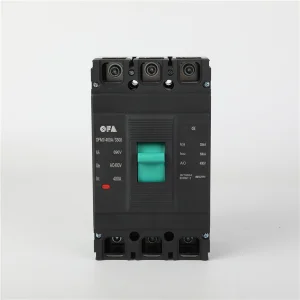
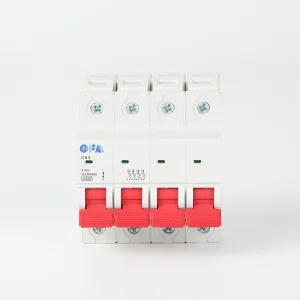
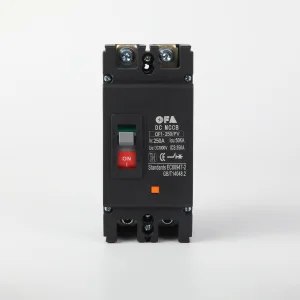
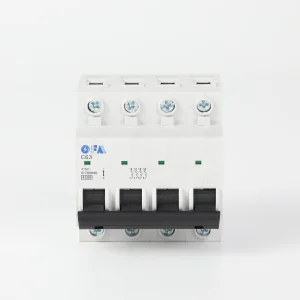
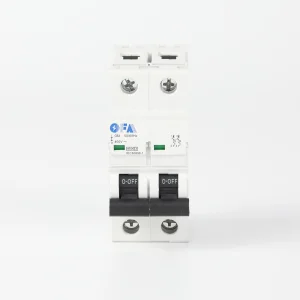
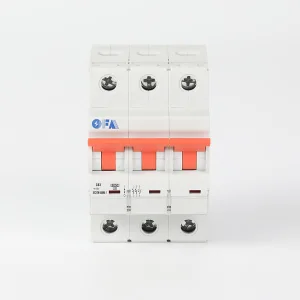
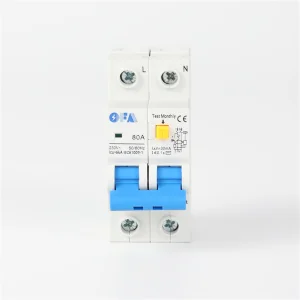
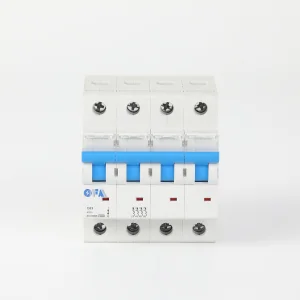
Explore our precision-engineered Direct Current (DC) Protection Portfolio. Verified to rigorous IEC 60947-2, IEC 60898-2, and UL standards for solar PV, battery energy storage, and industrial automation.
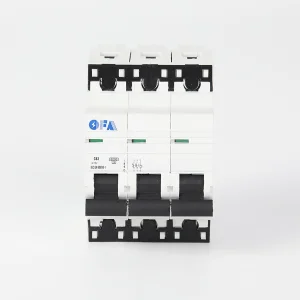
Analyzing the pivotal shift from traditional AC power distribution toward high-efficiency Direct Current (DC) architectures across industrial, commercial, and utility sectors.
The global electrification landscape is experiencing a paradigm shift driven by the rapid adoption of renewable energy resources, high-density Battery Energy Storage Systems (BESS), electric vehicle charging infrastructure, and hyper-scale data centers. Within this evolving ecosystem, the 60 Amp DC Circuit Breaker has emerged as a fundamental protection building block. Operating as a crucial defensive barrier against overcurrents, thermal runaway, and catastrophic short-circuit events, the 60A DC breaker bridges the gap between low-power consumer electronics protection and massive utility-scale switchgear.
Unlike Alternating Current (AC) systems, where current naturally crosses zero volts 100 or 120 times per second—providing a dynamic opportunity to extinguish electric arcs—Direct Current maintains a constant, non-zero voltage differential. This continuous energy flow makes interrupting a 60 Amp DC fault arc exponentially more complex. When a circuit breaker trips under 60A DC loads at voltages ranging from 12V DC to 1500V DC, a sustained plasma arc is formed. Without specialized internal arc-chutes, permanent magnetic blowout runners, and high-purity silver contact matrices, the arc can cause catastrophic housing melting, pole welding, and fire hazards.
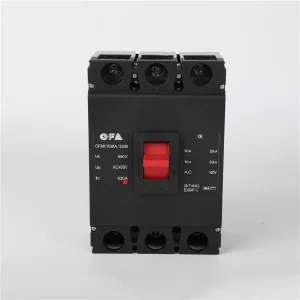
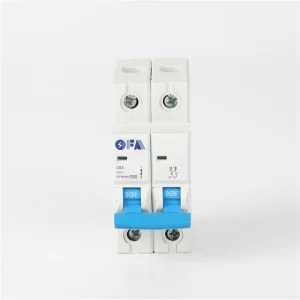
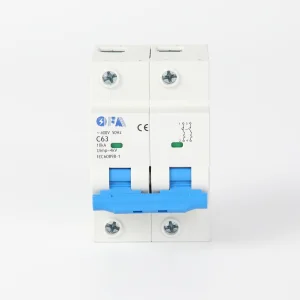
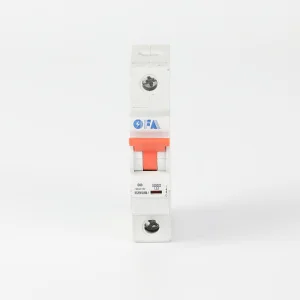
In solar photovoltaic (PV) string monitoring, high-amperage commercial battery racks (48V to 1000V DC), and telecom DC busbars, 60 Amperes represents the sweet spot. It maximizes energy density while operating within manageable thermal dissipation envelopes for DIN-rail mounted Miniature Circuit Breakers (MCBs) and compact Molded Case Circuit Breakers (MCCBs). Specifying certified 60A DC circuit breakers ensures optimal overcurrent selectivity without incurring unnecessary footprint expansion or exorbitant component costs.
Understanding internal physics, magnetic arc extinction mechanisms, thermal derating, and breaking capacities of 60A DC Breakers.
Integrated permanent magnets position near the main contacts create a Lorentz force, instantly driving the high-voltage DC arc up into arc-splitter plates for sub-millisecond suppression.
Advanced non-polarized magnetic geometry allows current flow in both charge and discharge directions, preventing catastrophic failure if miswired in complex storage environments.
Rated Ultimate Short-Circuit Breaking Capacity (Icu) reaching 6kA, 10kA, up to 20kA depending on frame sizes (MCB vs MCCB) and multi-pole series connections.
Below is the standard engineering specification benchmark utilized by Wenzhou OFA Electrical Technology Co., Ltd. for manufacturing enterprise-grade 60A DC circuit protection devices:
| Technical Parameter | Miniature DC Breaker (MCB) | Molded Case DC Breaker (MCCB) | Testing Standard / Compliance |
|---|---|---|---|
| Rated Current (In) | 60 Amp (Adjustable/Fixed Thermal) | 60 Amp (Precision Trip Mechanism) | IEC 60947-2 / UL 489B |
| Rated Operational Voltage (Ue) | 1P: 250V DC | 2P: 500V DC | 4P: 1000V DC | 2P: 500V DC | 3P: 750V DC | 4P: 1500V DC | GB/T 14048.2 / EN 60947-2 |
| Ultimate Breaking Capacity (Icu) | 6 kA - 10 kA | 10 kA - 25 kA | IEC 60947-2 Test Sequence I & II |
| Service Breaking Capacity (Ics) | 75% Icu or 100% Icu | 100% Icu | IEC 60947-2 Annex H |
| Tripping Curve Characteristics | Type B (3-5 In), Type C (7-10 In), Type D (10-14 In) | Thermal-Magnetic Adjustable (0.7-1.0x In) | IEC 60898-2 Curve Norms |
| Contact Material Alloy | High-Purity AgSnO2 (Silver Tin Oxide) | Heavy-Duty AgW / AgSnO2 Composite | RoHS & REACH Compliant |
| Mechanical & Electrical Life | 20,000 Ops Mechanical / 8,000 Ops Electrical | 25,000 Ops Mechanical / 10,000 Ops Electrical | IEC 60947-2 Endurance Protocols |
| Enclosure Flame Retardancy | UL94-V0 Thermosetting Polycarbonate | High-DMC Glass-Reinforced Polyester | UL94 Flammability Test |
How 60 Amp DC Circuit Breakers safeguard vital infrastructure in diverse environmental conditions worldwide.
In large-scale solar farms across desert regions (e.g., Middle East, US Southwest, Atacama), 60A DC circuit breakers are mounted inside outdoor combiner boxes. They protect high-voltage strings (up to 1000V/1500V DC) against reverse currents, line-to-line faults, and atmospheric surge overcurrents. Flame-retardant housings rated for extended ambient temperature ranges (-40°C to +70°C) are critical.
Lithium-Ion (LiFePO4) battery packs operating at 48V, 125V, or 500V nominal DC rely on 60A DC breakers for module-level isolation. During thermal runaway or dead-short scenarios, the 60A breaker trips within milliseconds, disconnecting the faulty battery string before fault currents exceed the maximum rating of battery management systems (BMS).
5G cellular base stations and mission-critical data center busways utilize central -48V DC power distribution cabinets. 60A DC MCBs safeguard rectifier modules and remote radio heads (RRH), delivering uninterruptible service reliability with zero tolerance for nuisance tripping caused by high-frequency power switching noise.
In electric mining haulers, marine vessels, and commercial EV fast-charging stations, 60A DC circuit breakers manage auxiliary power distribution lines. They provide reliable disconnection in high-vibration, high-humidity environments, adhering to severe automotive and maritime shock standards.
Next-generation technological convergence: Solid-State Breakers, Smart IoT Telemetry, and Eco-Friendly Arc Materials.
As smart grids and microgrids become increasingly digitized, protection devices are evolving from passive electromechanical switches into intelligent edge nodes. Wenzhou OFA Electrical Technology Co., Ltd. is actively investing in research and development to address three key multi-year technology trends:
Traditional mechanical air-gap breaker tripping takes between 5 to 15 milliseconds. However, in low-inductance lithium battery networks, short-circuit current rise rates ($di/dt$) can exceed tens of thousands of amperes per millisecond. The industry roadmap points directly toward Solid-State Circuit Breakers (SSDCBs) utilizing Silicon Carbide (SiC) or Gallium Nitride (GaN) power semiconductors. SSDCBs achieve arc-free interruption in under 10 microseconds. Hybrid designs combine physical contact galvanic isolation with semi-conductor ultra-fast switching.
Future 60 Amp DC circuit breakers will integrate embedded shunt micro-sensors and microcontrollers natively communicating via RS485 Modbus RTU, CAN bus, or wireless Matter/Wi-Fi protocols. This allows facilities managers to remotely monitor real-time parameters including:
In alignment with EU RoHS and REACH environmental mandates, modern breaker manufacturing is eliminating toxic cadmium from silver contact compositions. The industry has fully transitioned to Silver Tin Oxide ($AgSnO_2$) and Silver In2O3 alloys, which offer superior arc-erosion resistance, minimal contact welding tendencies, and environmental safety during lifecycle disposal.
Founded in 2013 in Yueqing, Wenzhou—the renowned Capital of Electrical Appliances in China—Wenzhou OFA Electrical Technology Co., Ltd. is a premier high-tech enterprise specializing in low-voltage distribution switchgear, control equipment, and solar DC protective devices.
Upholding the core values of "Professionalism, Integrity, and Pragmatic Innovation," OFA operates advanced automated assembly lines, digital inspection stations, and full-process type testing laboratories. Certified under ISO9001 quality management systems and recognized as a Grade A Tax Credit Enterprise for 7 consecutive years, OFA serves over 780 international partners across 50+ countries.
Expert engineering answers to common technical queries regarding 60 Amp DC Circuit Breaker selection, wiring, standards, and OEM customization.
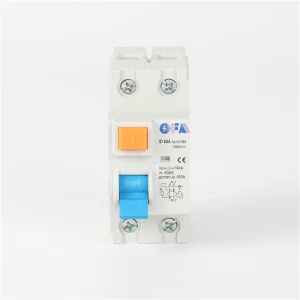
Browse our additional high-performance Circuit Breakers, Earth Leakage Protection (RCBO/RCCB), and Isolator Switches engineered by OFA.
 OFA Electrical