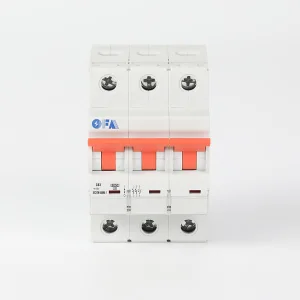
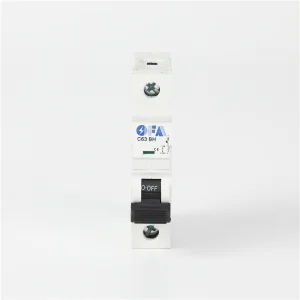
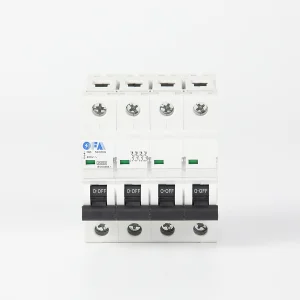
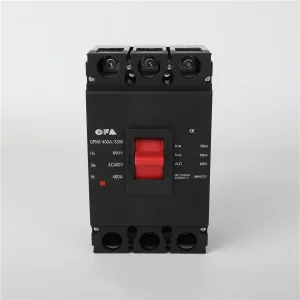
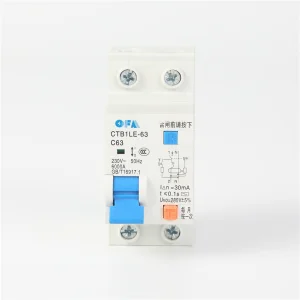
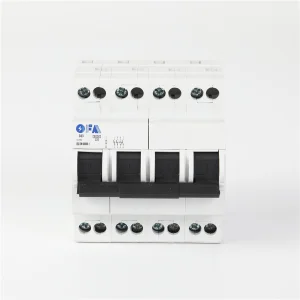
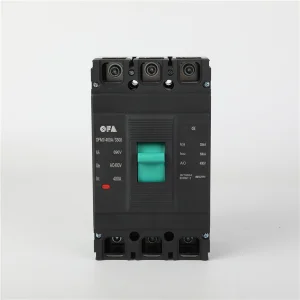
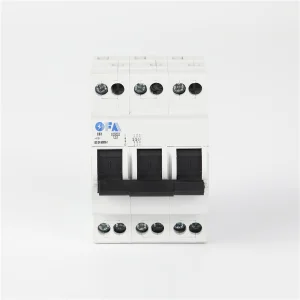
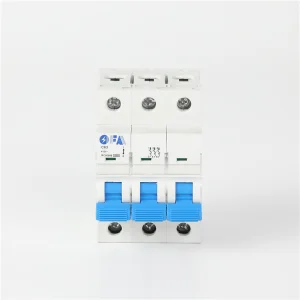
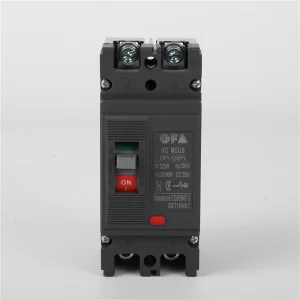
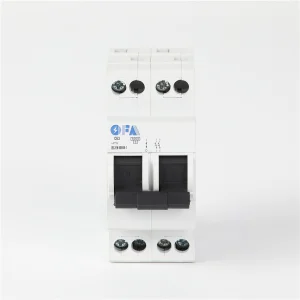
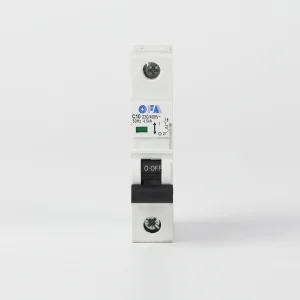
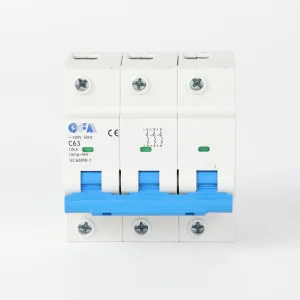
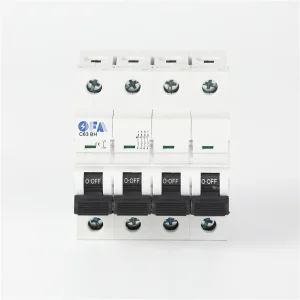
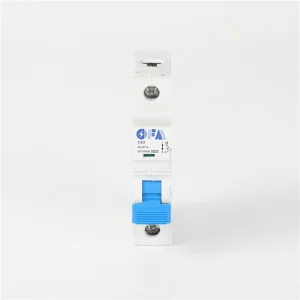
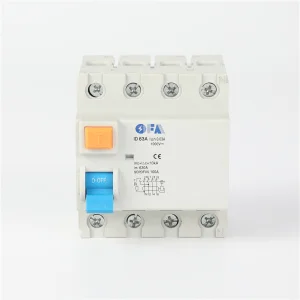
Precision-engineered miniature circuit breakers (MCBs), residual current devices (RCCB), and molded case breakers (MCCB) for global OEM/ODM applications.
The global electrical landscape is undergoing a fundamental structural transition from traditional Alternating Current (AC) distribution topologies toward high-efficiency Direct Current (DC) architectures. Driven by the aggressive expansion of utility-scale Solar Photovoltaics (PV), Battery Energy Storage Systems (BESS), Electric Vehicle (EV) ultra-fast charging infrastructures, and hyperscale Data Centers, the demand for robust DC DIN rail circuit breakers has escalated globally.
Modern PV installations operate at elevated system voltages up to 1000V DC and 1500V DC to minimize $I^2R$ transmission line losses. Standard AC breakers are incapable of interrupting DC arcs due to the absence of a natural voltage zero-crossing. Highly specialized DC DIN rail MCBs engineered with permanent magnetic blowouts are imperative for string boxes and inverter input stages.
Energy storage systems require bidirectional protection capable of handling high short-circuit prospective currents ($I_{cp}$). DC DIN Rail MCBs and MCCBs provide precise isolation for lithium-ion battery racks, preventing catastrophic thermal runaway events by swiftly extinguishing high-energy faults in fractions of a millisecond.
DC Fast Chargers (DCFC) demand ultra-reliable circuit isolation for internal auxiliary power lines, sub-distribution modules, and controller circuits. Compact 35mm DIN rail mounting allows panel builders to optimize space inside weather-proof enclosure cabinets operating under severe climatic stress.
Designing circuit breakers for Direct Current applications presents unique physics-based challenges. Understanding these electrodynamic mechanisms is essential for engineering consultants, EPC contractors, and OEM panel builders when specifying protection components.
In standard 50Hz/60Hz Alternating Current circuits, the current naturally passes through zero amplitude twice every cycle (every 10 milliseconds in a 50Hz grid). This zero-crossing point allows the ionization between separated contacts to naturally collapse, making arc interruption relatively straightforward using conventional arc chutes and splitter plates.
Direct Current maintains continuous, uninterrupted voltage and current flow without natural zero-crossings. When contact tips separate under load or short-circuit fault conditions, an intense, high-temperature electric plasma arc is sustained. To extinguish this arc, the internal breaker geometry must forcibly stretch, cool, and segment the arc instantly.
China DC DIN Rail Breaker Manufacturers employ rare-earth permanent magnets embedded adjacent to the contact arc zone. The magnetic field exerts a Lorentz Force ($\vec{F} = I \cdot \vec{L} \times \vec{B}$) on the ionized gas plasma, physically pushing the arc into the multi-plate arc chute where it is split into series sub-arcs and rapidly cooled.
| Parameter | AC Circuit Breaker (MCB) | DC DIN Rail Breaker (DC MCB) |
|---|---|---|
| Current Zero-Crossing | Yes (Every 10ms at 50Hz) | None (Continuous DC flow) |
| Arc Extinction Method | De-ionization at zero-crossing | Magnetic blowout + Arc stretching |
| Polarity Sensitivity | Non-polarized | Polarized (+/- designated) or Non-Polarized |
| Rated Voltage per Pole ($U_e$) | 230V / 400V AC | 250V DC per pole (up to 1200V 4P) |
| Internal Contact Distance | Standard gap (3-5mm) | Extended gap + Silver Alloy Tips |
| Standards Compliance | IEC / EN 60898-1 | IEC / EN 60947-2 & EN 60898-2 |
China’s dominance in the low-voltage apparatus sector is rooted in the industrial cluster of Yueqing, Wenzhou—widely recognized as the "Capital of Electrical Appliances in China." Wenzhou OFA Electrical Technology Co., Ltd. leverages this unique ecosystem to provide unmatched manufacturing capabilities, cost optimization, and rigorous compliance.
From precision silver-alloy contact stamping, thermosetting mold injection (BMC/PMC flame-retardant housings), to copper coil winding and bimetal thermal strip calibration—100% of sub-components are manufactured within a 15-kilometer operational radius. This drastically eliminates lead-time delays and raw material supply bottlenecks.
Modern Chinese breaker plants utilize multi-station automated assembly lines equipped with machine-vision inspection systems. Thermal-magnetic tripping curves are 100% calibrated using automated current-injection testing rigs, guaranteeing zero out-of-factory trip curve tolerance drift.
Quality assurance follows strict Standard Operating Procedures (SOPs). Products undergo extensive type-testing including instantaneous short-circuit interrupting capacity ($I_{cn}$), temperature-rise limits ($\Delta T \le 60K$), mechanical endurance under load, and glow-wire flammability testing ($960^\circ\text{C}$).
DC DIN rail circuit breakers serve as the foundational protection layer across multiple industrial and commercial infrastructure projects globally.
In decentralized rooftop and ground-mounted solar farms, DC MCBs (such as the DCOF1-125/PV series) are mounted inside weatherproof IP65 distribution enclosures. They protect photovoltaic modules against reverse current flow caused by partial shading or short circuits in adjacent string configurations.
Battery energy storage units demand non-polarized bidirectional breakers. Since power flows into the battery during charging and out during discharging, standard polarized DC breakers risk catastrophic failure if current reverses. Chinese manufacturers have engineered non-polarized magnetic systems that ensure arc extinction regardless of current direction.
Modern data centers are transitioning to -48V DC and 380V DC distribution grids to eliminate double AC-DC conversion efficiency losses. Compact 18mm-per-pole DIN rail breakers provide selective protection for high-density server racks, preventing localized fault propagation from shutting down critical server infrastructure.
Direct current protection is essential inside EV fast chargers to isolate sub-circuits and safeguard power conversion modules. Similarly, DC DIN rail breakers protect auxiliary control units in electric trains, trams, and trackside signaling systems subject to high vibration environments.
Founded in 2013, Wenzhou OFA Electrical Technology Co., Ltd. has established itself as a premiere manufacturer of low-voltage electrical distribution and switchgear control equipment. Operating with independent brand equity ("OFA"), the company serves over 780 international partners across 50+ countries.
OFA has been officially rated as Tax Credit Grade A for 7 consecutive years, demonstrating impeccable compliance, corporate integrity, and operational financial stability for long-term international trade partnerships.
Operating under strict ISO9001 quality management guidelines, our manufacturing processes include end-to-end component traceability, digital visual inspections, and 100% automated dielectric and tripping verification prior to packaging.
OFA offers extensive low-voltage product lines including Air Circuit Breakers (ACB), Molded Case Circuit Breakers (MCCB), Miniature Circuit Breakers (MCB), Residual Current Breakers (RCCB/RCBO), and Isolator Switches (IS).
Clear, authoritative technical answers to assist procurement directors, panel builders, and electrical engineers in selecting the correct DC DIN Rail Circuit Breakers.
Explore our full line of miniature circuit breakers, high-capacity molded case breakers, and specialized leakage protection devices.
Get direct factory pricing, comprehensive OEM/ODM engineering support, and rapid global delivery for your solar PV, BESS, or industrial projects.
Contact Our Engineering Team OFA Electrical